
The Volcanoes of Santorini: Caldera, Nea Kameni, Palea Kameni & Kolumbo
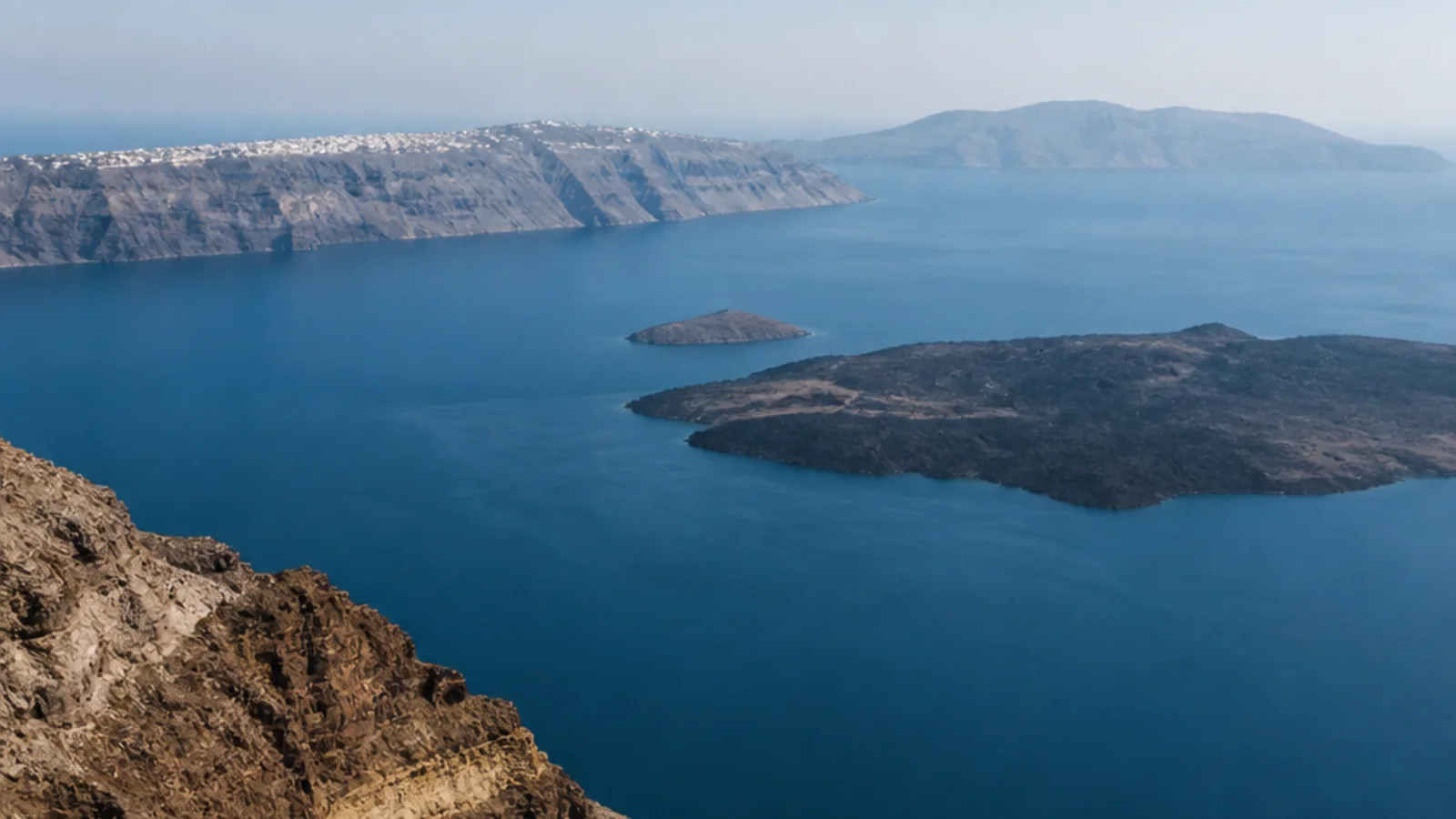
Santorini is not shaped by a single visible volcano. Its landscape belongs to a wider volcanic system that includes the caldera, Nea Kameni, Palea Kameni and the nearby submarine volcano of Kolumbo.
Quick Answer: What Are the Volcanoes of Santorini?
Santorini Caldera
A large sea-filled volcanic depression and the geological setting for the island’s cliffs and central islets.
Nea Kameni
The dark volcanic island inside the caldera where organised boat trips may land for a walking visit.
Palea Kameni
A volcanic island associated with the warm-water area commonly called Santorini’s hot springs.
Kolumbo
A separate submarine volcano northeast of Santorini, important for research and not a walkable tourist island.
South Aegean Volcanic Arc
The broader tectonic and volcanic context linking Santorini with other volcanic centres in the Aegean.
Santorini's Volcanic Landscape at a Glance
| Volcanic feature | Location | What it is | Can visitors see or visit it? | Important clarification |
|---|---|---|---|---|
| Santorini Caldera | Central Santorini and surrounding sea | A large volcanic depression shaped by major eruptions and collapse | Yes, from caldera villages, viewpoints and the sea | It is a landform and volcanic system, not one simple crater. |
| Nea Kameni | Inside the caldera | A younger volcanic island built by lava flows and domes | Often, on an organised boat landing | Access, route and conditions depend on the operator and official guidance. |
| Palea Kameni | Inside the caldera | An older Kameni island formed by later volcanic activity | Seen from the water; some itineraries stop near the warm-water area | The water temperature and swim conditions can vary. |
| Kolumbo | Submarine, northeast of Santorini | An underwater volcano in the wider volcanic field | Seen as a scientific feature, not a walkable island | It is not the same volcanic centre as Nea Kameni. |
How Was the Santorini Caldera Formed?
The Santorini caldera is a large volcanic depression, not simply a small crater at the top of one cone. Its present form reflects multiple eruptive episodes, the removal of volcanic material and collapses of the ground above the magma system over a very long geological history. The sea now occupies much of that depression.
Thera, Therasia and Aspronisi form the familiar caldera rim, with Palea Kameni and Nea Kameni in the centre. The cliffs around Fira, Firostefani, Imerovigli and Oia expose layers of volcanic deposits.
The International Union of Geological Sciences description of the Quaternary Santorini Caldera emphasises the volcanic-arc setting and the evidence of multiple eruptive episodes in the caldera walls. That broader context matters: one dramatic eruption is part of the story, but it does not explain every layer or every island visible today.
The Minoan Eruption and Ancient Akrotiri
The Late Bronze Age eruption is often called the Minoan eruption or the Thera eruption. It was a major event in the development of the present caldera landscape and is usually discussed at around 3,600 years before present. Exact dating has been examined with different archaeological and scientific methods, so it is better to describe the period than to present one disputed year as absolute.
Ancient Akrotiri is important because ash and volcanic deposits preserved a prehistoric settlement, including streets, buildings and wall paintings. It connects the geological event with a real Bronze Age community; the popular Atlantis connection remains a hypothesis, not an established historical fact.
For the archaeological side of the story, read our Santorini archaeological sites guide before combining Akrotiri with a southern-island route. The visit has a different purpose from a boat day to Nea Kameni.
Nea Kameni: The Volcano Inside the Caldera
Nea Kameni is the dark, younger volcanic island at the centre of the caldera. It formed progressively through later eruptions that built lava domes and flows, rather than appearing as one simple cone at one moment. Organised boat itineraries may land visitors near a walking route where the exposed ground, crater forms and layers of volcanic rock make the island feel very different from the white villages on the rim.
The latest confirmed eruption in the Kameni islands occurred in 1950. The Smithsonian Global Volcanism Program records explosive and effusive activity at Nea Kameni, while NASA describes small explosions and lava production. This historical fact is not a forecast or a statement about current conditions.
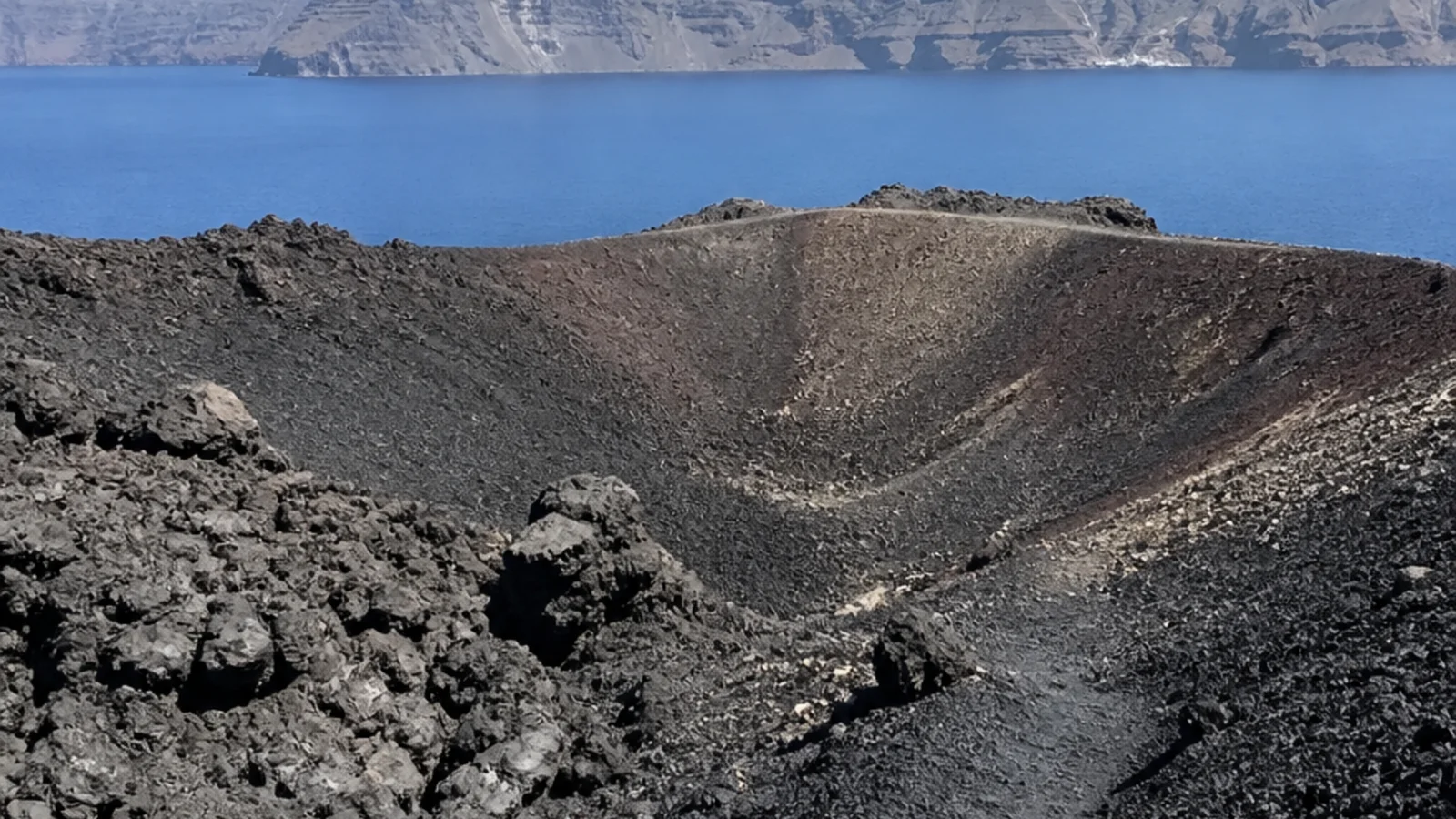
A visit is a short field experience rather than a conventional attraction with one fixed route. Shade, surfaces, heat, wind and the final landing arrangement matter. Check the current operator itinerary, access instructions and official guidance before deciding whether the walk suits your group.
Palea Kameni and the Hot Springs
Palea Kameni is another volcanic island inside the caldera, formed by later activity. It is commonly associated with the warm-water area that many travel itineraries call the Santorini hot springs. This is the practical distinction: Nea Kameni is usually the island walk, while Palea Kameni is linked with the water stop.
The temperature, access, sea state and time available at the stop can change. Follow the boat operator's instructions and do not treat a swim as guaranteed. For the practical excursion experience, packing and departure-point planning, use the existing Santorini Volcano & Hot Springs boat-trip guide, which remains the main article for that tourist experience.
Kolumbo: Santorini's Underwater Volcano
Kolumbo is a submarine volcano northeast of Santorini in the Aegean Sea. It belongs to the wider Santorini volcanic field, but it is not the same volcanic centre as Nea Kameni. Its underwater setting makes it important for marine and volcanic research, not a destination where visitors can land and walk around.
“Santorini volcano” may refer to the caldera system, Nea Kameni as the accessible island, or the wider field that also includes Kolumbo. The Global Volcanism Program lists research on Kolumbo; scientific monitoring remains the source for current information.
Is the Santorini Volcano Active?
Santorini is described as an active volcanic system because it has documented eruptions in the historical and geological record and is monitored by scientific institutions. “Active” does not mean that an eruption is happening now. “Dormant” and “extinct” are technical terms with different uses, and seismic activity alone is not the same thing as a volcanic eruption or a confirmed volcanic emergency.
For current information
For current monitoring information or safety instructions, visitors should consult the Greek Civil Protection authorities and the Institute of Geodynamics of the National Observatory of Athens. Travel articles should not replace an official notice.
The Institute of Geodynamics publishes monitoring and seismic information, while the Greek Civil Protection authorities publish official instructions and public-safety information. Use those channels for the current situation instead of relying on an old blog post, social-media claim or a tour description.
Can You Visit the Santorini Volcano?
Visitors can usually reach Nea Kameni through an organised boat excursion, but the actual operator, departure point, programme, landing arrangement and weather policy must be confirmed for the travel date. Fira Old Port is not interchangeable with Athinios Port, and not every itinerary uses the same marina or meeting point.
- Confirm the operator and exact meeting point before arranging road transport.
- Check the current departure time, return plan and weather policy.
- Wear secure shoes and bring water and sun protection for exposed volcanic ground.
- Do not assume that Kolumbo is an accessible island stop.
- Follow official access and safety instructions on the day.
KC Travel is not a boat-tour operator or scientific authority. Where available, KC Travel can review a road-transfer request to a confirmed vehicle-accessible meeting point. The marine operator remains responsible for the excursion, route and conditions.
Planning Transportation to the Volcano Tour
Once the operator confirms the meeting point, plan the road leg separately. A hotel-to-Fira transfer may be appropriate for a Fira Old Port departure; an airport arrival may need a connection to Fira, Oia or another hotel before the excursion day; and an Athinios ferry arrival may need luggage handling before the group continues inland.
Share the exact hotel name, passenger count, luggage, pickup time and confirmed operator location in the existing KC Travel booking form. Vehicle access can stop short of caldera properties, old-port approaches and narrow village lanes, so allow time for a final walk.
For arrival planning, see the Santorini Airport transfer guide, port transfer guide and private transfer guide. These explain the road journey without implying that every boat tour uses one fixed departure point.
Other Volcanic Places to Explore
The volcanic story continues beyond the central islands. Ancient Akrotiri connects the Bronze Age settlement with the Minoan deposits, while Red Beach and black-sand beaches show how volcanic material shapes the coast. Access can vary, so follow current official instructions.
Inland, Pyrgos and Megalochori offer a different view of the island: traditional settlements, vineyards, churches and roads built within the constraints of volcanic terrain. Fira, Imerovigli and Oia sit along the caldera rim, where the layered cliffs are part of the landscape rather than just a background for photographs.
For route ideas, compare our Santorini beaches guide, traditional villages guide and Fira-to-Oia caldera walking guide. They cover different travel experiences and should not be treated as substitutes for official access notices.
Why Choose KC Travel for Your Transportation?
KC Travel provides airport transfers, port transfers, hotel transportation and private road transfers across Santorini. For a volcano-tour day, the useful service is transportation to a confirmed meeting point, not a promise about the boat itinerary itself.
Add your flight or ferry details, accommodation, group size, luggage, sports or mobility equipment and the confirmed operator location to the existing booking request. KC Travel can review the practical road journey and availability without presenting itself as the tour operator, scientific body or emergency authority.
Scientific and Official Sources
This guide uses the following sources for its geological and monitoring context. They are provided for further reading; current safety instructions always come from the competent Greek authorities.
- Smithsonian Institution Global Volcanism Program — Santorini
- International Union of Geological Sciences — The Quaternary Santorini Caldera
- NASA Earth Observatory — Santorini's Hidden Worlds
- NASA Earth Observatory — Santorini Volcano, Greece
- Institute of Geodynamics, National Observatory of Athens
- Hellenic Ministry for Climate Crisis and Civil Protection
ARRANGE YOUR SANTORINI TRANSFER
Confirm your tour's departure point first, then use KC Travel's booking form for your airport, port, hotel or meeting-point transfer.
Open the Booking Form →Santorini Volcanoes FAQ
How many volcanoes are there in Santorini?
Santorini is best understood as a volcanic field and caldera system rather than a list of separate cone-shaped volcanoes. The landscape includes the caldera, the Kameni islands of Nea Kameni and Palea Kameni, and the nearby submarine volcano of Kolumbo within the wider South Aegean volcanic arc.
Is the Santorini volcano active?
Santorini is a volcanically active system in the scientific sense, with a record of eruptions and ongoing monitoring. That wording does not predict an eruption or describe a current emergency. For present conditions, visitors should use updates from the Institute of Geodynamics and Greek Civil Protection authorities.
When did the Santorini volcano last erupt?
The most recent confirmed eruption in the Kameni islands occurred in 1950, when small explosions and lava were reported at Nea Kameni. Historical records include earlier eruptions inside the caldera. The date refers to documented volcanic activity, not a prediction about future activity or a statement about current safety conditions.
What is the Santorini caldera?
A caldera is a large volcanic depression formed when the ground above a magma system collapses after a major eruption or a sequence of volcanic events. Santorini’s caldera is the sea-filled centre of a broader volcanic landscape, bordered by Thera, Therasia, Aspronisi and the younger Kameni islands.
Is Nea Kameni the main Santorini volcano?
Nea Kameni is the best-known volcanic island inside the caldera and the place many visitors reach on an organised boat itinerary. It is not the whole Santorini volcanic system. Its lava domes and flows record later activity inside the caldera, while Kolumbo is a separate submarine volcanic centre.
What is the difference between Nea Kameni and Palea Kameni?
Nea Kameni is the larger, younger volcanic island associated with the walking route and visible crater landscape. Palea Kameni is another volcanic island in the caldera, commonly linked with the warm-water area called the hot springs. They formed through later activity, but they are not interchangeable names for one island.
What is the Kolumbo underwater volcano?
Kolumbo is a submarine volcano northeast of Santorini in the Aegean Sea. It is part of the wider Santorini volcanic field but is not the same volcanic centre as Nea Kameni. Because it is underwater, visitors should treat it as a scientific and geological feature rather than a walkable island attraction.
Can visitors walk on the Santorini volcano?
Visitors can commonly walk on designated parts of Nea Kameni when an organised boat itinerary lands there, subject to the operator’s route, weather, access and any official instructions. The ground is exposed and uneven. Confirm the current itinerary and conditions; Kolumbo is underwater and is not a walkable tourist island.
How do visitors reach Nea Kameni?
Nea Kameni is normally reached by an organised boat excursion from a confirmed departure point such as Fira Old Port or another port used by the operator. Meeting points and itineraries vary. Confirm the exact departure, boarding instructions, return plan and weather policy directly with the current tour operator.
How can I arrange transportation to my volcano-tour meeting point?
First confirm the exact meeting point with the boat operator. KC Travel can review a road transfer request from Santorini Airport, Athinios Port or a hotel to a confirmed vehicle-accessible meeting point, subject to route and availability. Use the existing booking form and include the operator’s name, time and location.